
Understood without being said.
A concept outdoor and ski brand, built around one range of mountains and the rock it is made of.
01/Place
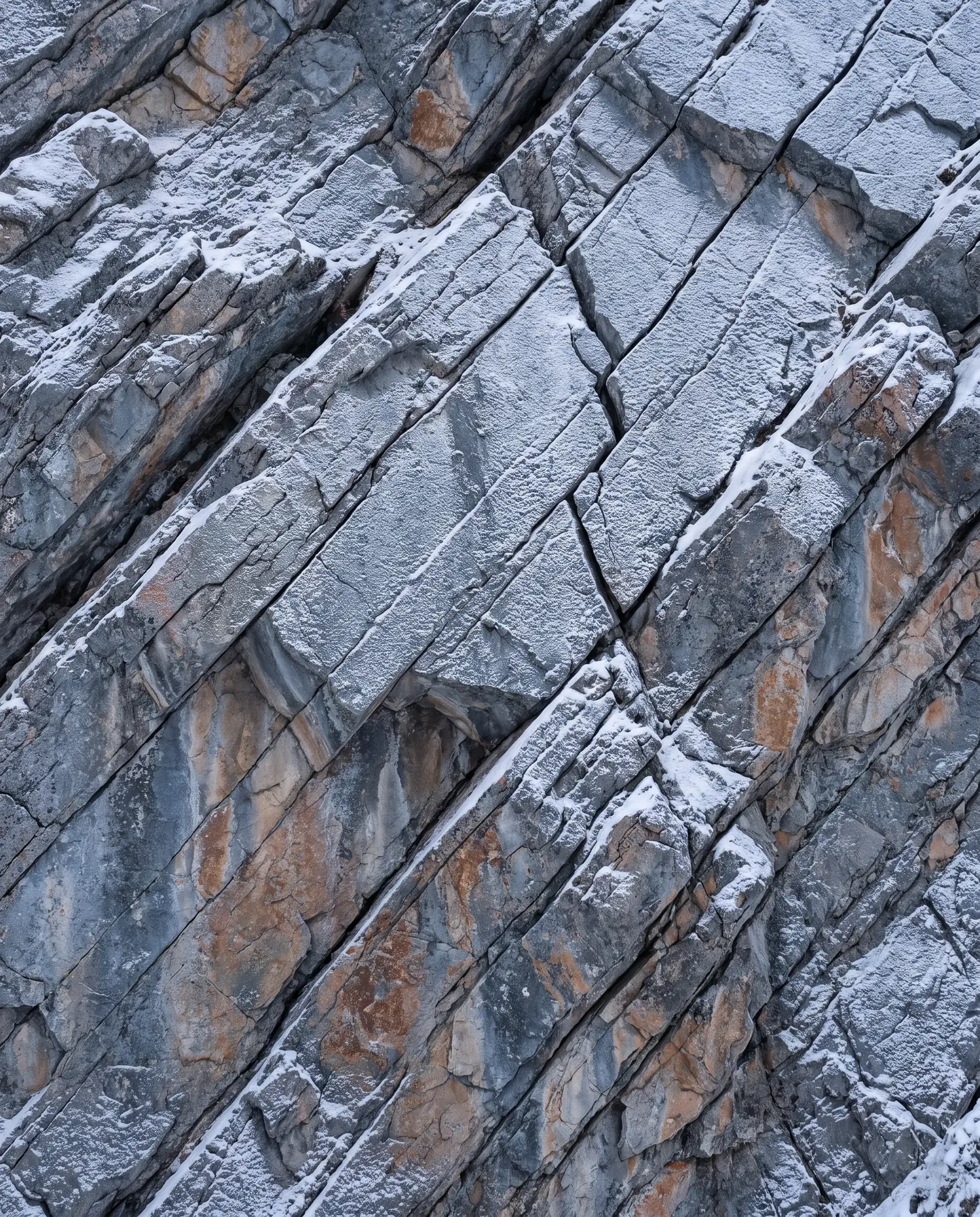
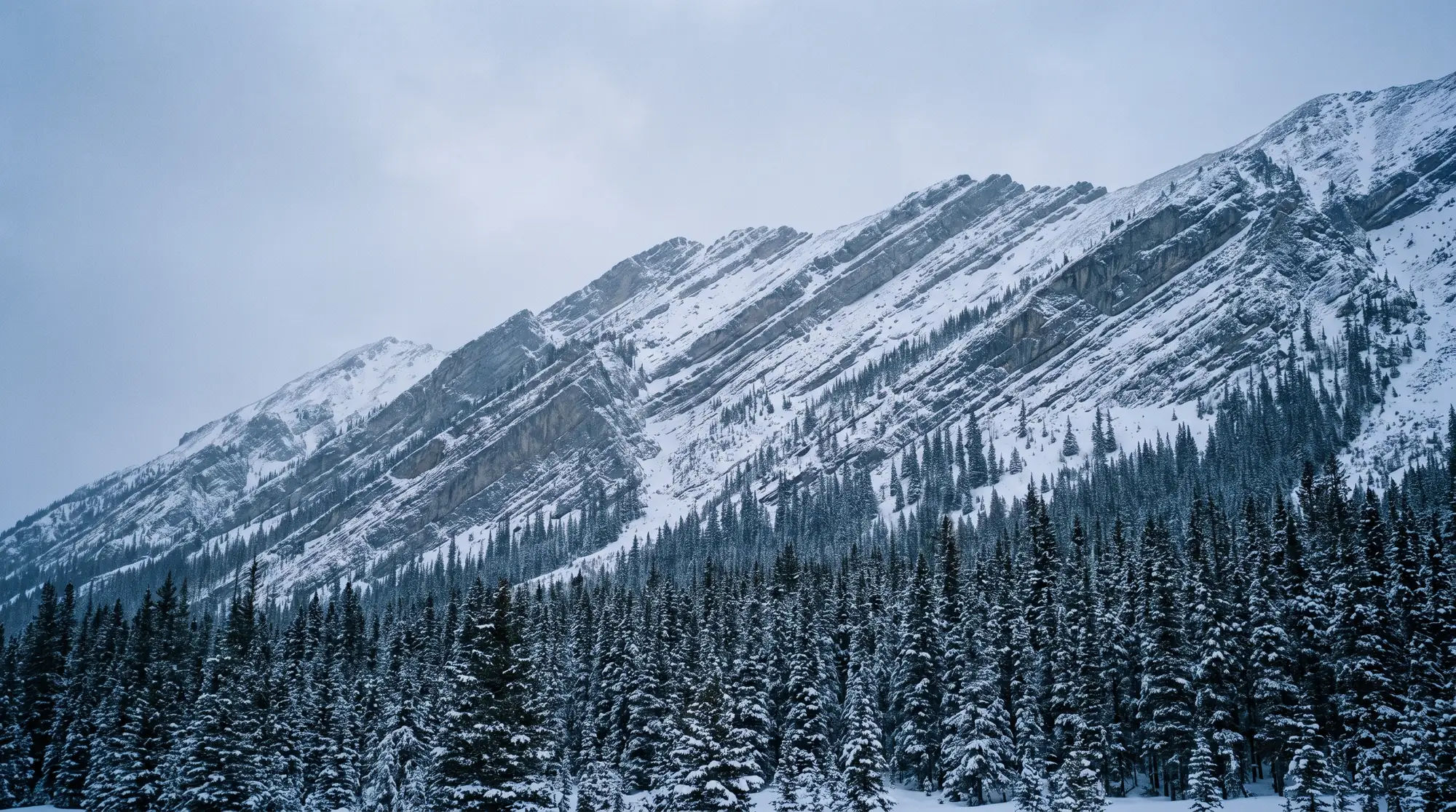
The Rockies are sedimentary.
Tilted limestone, stacked in visible bands and cut through on an angle. That banding is a real fingerprint of this particular range, and it is the one starting point the brand actually has.

02/Identity
Four bars,
cut by a fault line.
This started as a mountain silhouette with strata as internal detail, and got reduced until the strata carried the mark on its own. It reads as the geology itself.
Set in lowercase, weighted heavy, with no capital anywhere in the brand. The letterforms stay plain because the mark mostly appears small and on fabric: stitched into a hem, printed on a topsheet, pressed into a chest patch. It has to hold up at that size before it does anything else.
03/Signature
A carabiner at the side seam.
Most brands treat a hardware detail as a compromise to a clean product. Here it is the design. The loop is sewn into the reinforced seam allowance so it holds a real load, and it repeats on every outerwear piece in the line.
Carabiners in recycled aluminum. Zippers are YKK NATULON, recycled polyester, bluesign certified.
04/Outerwear
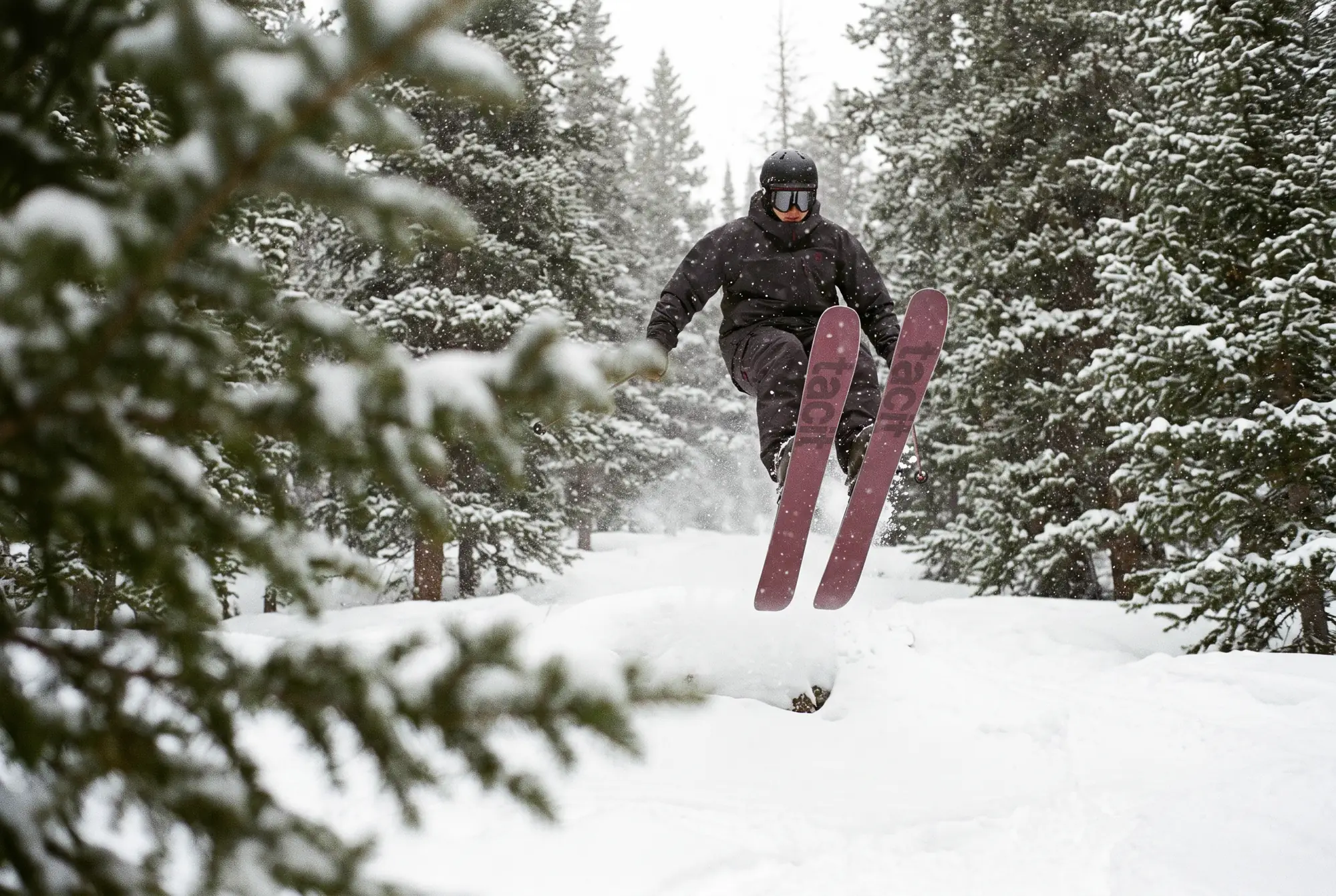
Burg · 96mm · Bow Valley glades
05/The collection
One fit language, head to boot.
Every piece is relaxed and slightly oversized, short of the exaggerated cut that reads as a single season: dropped shoulder, no taper at the knee, boxy through the body. That was decided once, for the whole line, and it's held to full technical standard underneath: recycled ripstop, PFC-free DWR, real hardware. Select any piece for detail.
06/Skis
Three shapes.
FSC-certified poplar and paulownia cores, flax and basalt fibre in place of fiberglass, bio-based epoxy resin. Every length runs the same construction, women’s lengths included. Dimensions and radius are quoted at the mid length. Toggle topsheet and base.
07/Women’s
Built the same, cut shorter.
Tops are cropped in length, because a full-length oversized silhouette reads differently on a shorter torso. Width and construction stay identical to the men’s versions, and so does the colourway range. Bottoms are full length across both lines.
08/Materials
Named plainly, then dropped.
Every standard here is real and already in use across the outdoor industry. State the material and the certification, then stop.
09/The case
Three things, holding at once.
Every established shell brand and ski label in this category already competes on quality, and none of them are cheap, so undercutting on price was never available. The relaxed ski silhouette is also having a moment of its own, mostly with brands from the fashion side, where technical performance tends to be the first thing cut to reach the look. Doing this properly takes three things holding at the same time.
Certified materials and the foundation share are both committed before a price is set, so they shape the cost base rather than coming out of margin later. That is what decides where the shelf price lands, and why competing on cost was never on the table.
A fully technical shell, held to the same standard as anything else on the mountain: recycled ripstop, a hood sized for a helmet, seams reinforced enough to carry real hardware. The relaxed cut costs none of it.
One fit language across the line, one hardware signature, one geology-based mark. The cut is relaxed enough to move in and stops short of the exaggerated proportions that date to a season, so the line still reads as itself in five years.
10/Where the money goes
A foundation, funded by every sale.
Using responsible materials does not answer the harder question, which is whether a company is just selling people things they don’t need. The answer here is structural: money leaves the business by rule, into a foundation Tacit does not control.
Set aside before profit is calculated, into a foundation legally separate from the company. Five times the one percent that has become the category’s usual pledge, and large enough that the business has to be built around it.
The foundation also raises its own money through grants, donors, and partnerships with brands sourcing from the same growers, so its budget is not capped by however much Tacit sells in a year.
The organic cotton growers, wool producers, and FSC-managed forest cooperatives who supply the materials.
Watershed and land stewardship in the Bow Valley, the specific valley whose geology shaped the brand’s icon.
11/Illustrative financials
The shape of the money.
Illustrative figures, mocked up for this proposal to show how the model works at the product level. Margins are representative of what comparable recycled and certified-material outdoor products run in the real market.
Each bar carries across the dashed line to the next, and a − marks what comes out. The foundation cut is taken before the business pays itself.
Both totals run the same length because they have to. Retained earnings is the $222K of operating income from the page before, and the $30K foundation payable is the part of the 5% still unpaid at year end.
12/Impact statement
More than a cheque.
Money is the easy part to report, which is exactly why a real impact statement can’t stop there. It also has to say who decides, what happens beyond the transfer, and what isn’t measured yet. One modeled year, four pages.
Both figures are tracked back to individual products rather than folded into one annual total.
Modeled from the year’s material mix and funded work, not measured outcomes. Comparisons are against the conventional material each certified input replaces.
Every employee gets one paid week a year to work directly for a funded organization, on its terms, instead of the company writing a cheque and calling it done. Modeled at roughly 200 hours across the team in year one.
One open work day a year in the Bow Valley, where customers and staff join the same stewardship groups the foundation funds. That year’s full list of grant recipients is published, not just the total given.
Grants are approved by a board independent of Tacit’s own management, seated with a representative from the growers and producers being funded. Money moves once a year, on a fixed schedule, and that disbursement is reviewed outside the company.
Free repairs for the life of the garment, run out of the same budget line. A repaired shell is the cheapest carbon saving available to an apparel brand, and the only one that doesn’t require selling anything.
A statement that only reports what went well is marketing. These are the gaps in the model above, named rather than left out.
Tacit does not calculate its full supply-chain footprint. The numbers opposite cover material substitution and funded work, which is the measurable slice, not the whole. Raw materials and manufacturing are where most apparel emissions actually sit.
Inbound and outbound shipping is not in any figure here. Air freight would move these numbers meaningfully in the wrong direction.
No third party has audited any of it. Real reporting at this level would need one, and the cost of that audit belongs in the P&L before the claims do.
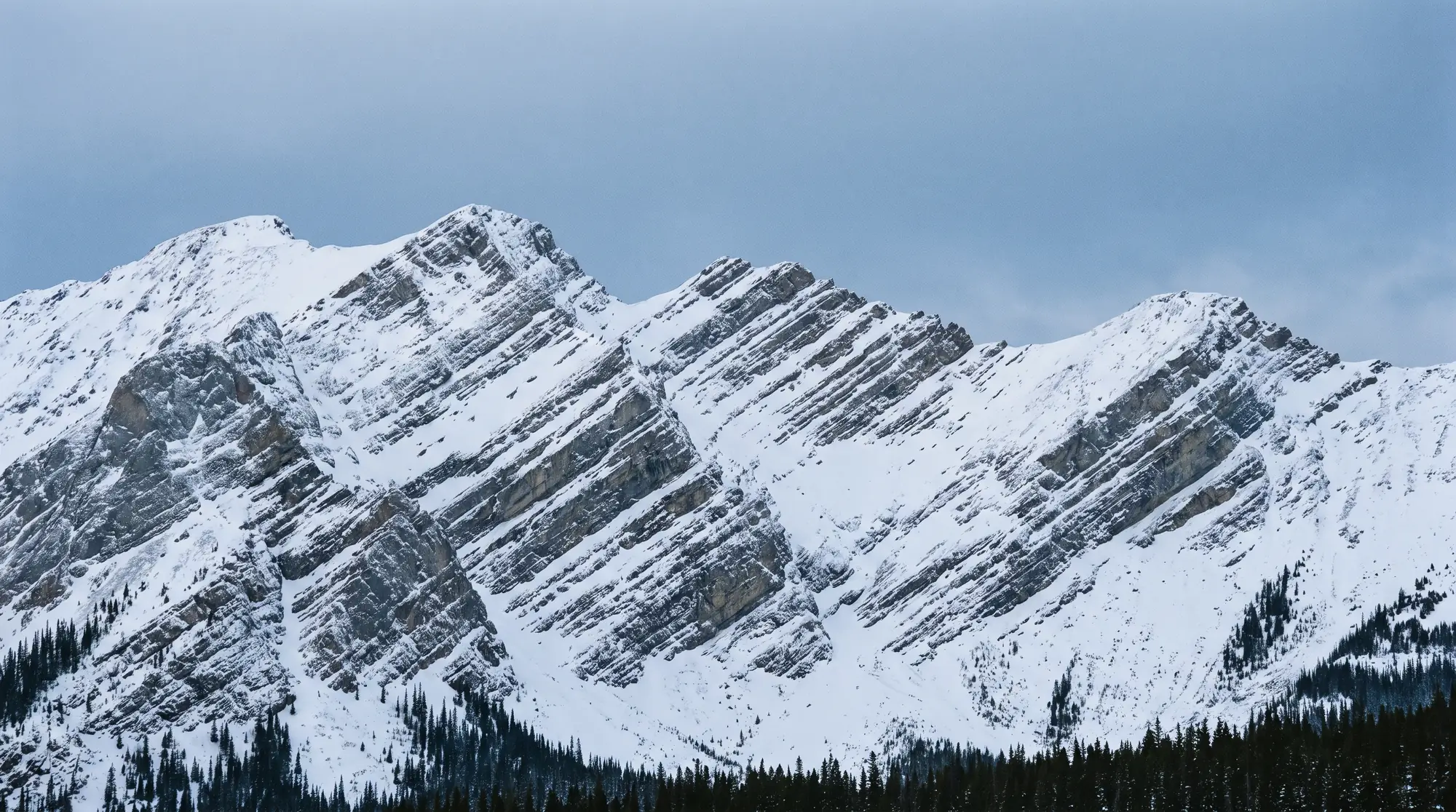
Tacit makes technical outdoor apparel and skis for the Canadian Rockies, cut in one relaxed fit across the whole line. A fixed share of every sale funds a foundation tied to the growers, producers, and forest cooperatives that supply the materials, and to the Bow Valley itself.
Concept brand and portfolio piece. Not a real company.
Identity, product line, and copy by Jackson Hamm. Every product shot and scene here is AI-generated, not photographed, which is why some construction details aren’t fully consistent.